The 2442 Aircraft Control & Warning Unit (Reserve) Vancouver was formed on April 1, 1950, to train personnel in radar operations for the new radar station then under construction, and to train the personnel in all aspects of aircraft control and warning. Training was carried out in quarters provided in the Reserve Centre on Hastings Street, in Vancouver, British Columbia.
On November 1, 1951, 2442 AC&WU was re-designated as 2442 Aircraft Control & Warning Unit (Auxiliary), and on December 1, 1953, the unit became a squadron. In the fall of 1951, the squadron moved to a building converted for it at RCAF Station Sea Island, and with the addition of up-to-date training equipment the work became both life-like and interesting. The number of personnel was enlarged and the unit prepared for the emergency that has not come in its lifetime. In the event of war or national emergency, they would have become "Guardians of the Sky" working from the completed "Pinetree" radar sites. They provided a strong reserve of trained manpower in a time when the Korean War was still on and the Cold War threatening to become warmer.
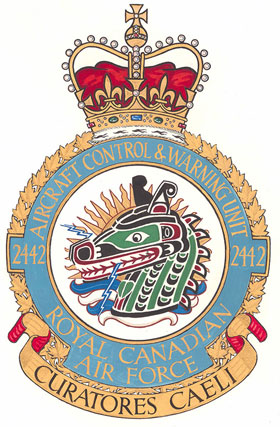
In the summer of 1955, the squadron entered its most active period with intensive training in radar control and the techniques of intercepting enemy aircraft. Summer training in the annual two-week camp was carried out at both USAF and RCAF radar sites. During this period the unit badge was returned from England after being inspected and authorized by Her Majesty the Queen. 2442 AC&WU Squadron adopted the mythical Coast Indigenous "Sisiutl" as its emblem, and the motto "Curatores Caeli" which translates as Guardians of the Sky. The Sisiutl is reputed to be able to bring down the Thunderbird with a glance from its eye.
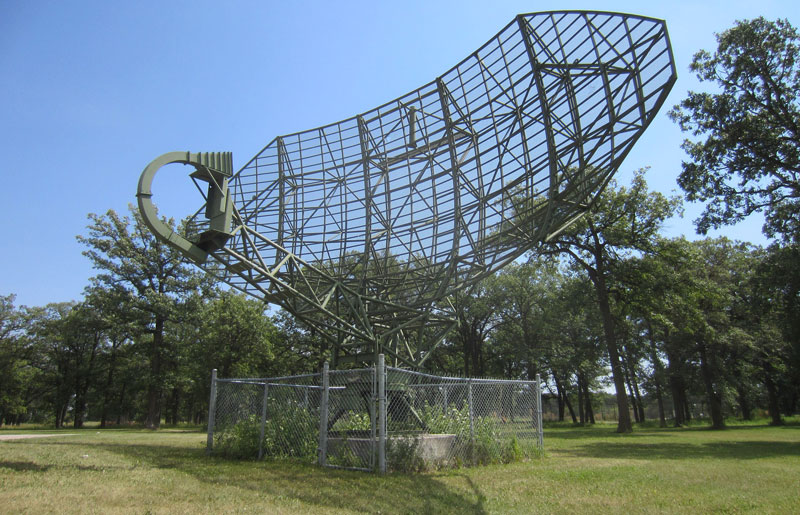
The Pinetree Line was a series of radar stations located across southern Canada at about the 50th parallel north, along with a number of other stations located on the Atlantic and Pacific coasts. Run by North American Aerospace Defense Command (NORAD) (after its creation), over half were staffed by United States Air Force personnel with the balance operated by the Royal Canadian Air Force. The line was the first coordinated system for early detection of a Soviet bomber attack on North America, but before the early 1950s radar technology quickly became outdated and the line was in full operation only for a short time.
2442 AC&WU Squadron was another victim of the Semi-Automatic Ground Environment (SAGE) system, a system of large computers and associated networking equipment that coordinated data from many radar sites. Consequently, it was disbanded on March 31, 1961.
In August 2025, retired Coquitlam City Councillor Terry O'Neill bought a framed copy of the 2442 AC&WU Squadron badge at a local thrift store which he donated to the Sea Island Heritage Society. In October 2025, the Richmond News wrote an article about this piece of history.
The article,"Richmond heritage society gets piece of 1950s RCAF history", caught the attention of the Office of the Secretary to the Governor General of Canada in Ottawa, Ontario. The Deputy Chief Herald of Canada referred the article to the Directorate of History and Heritage (DHH) of the Department of National Defence (DND). Through DND, the Society learned that:
- DHH is the custodian of the artwork related to all DND and Canadian Armed Forces (CAF) badges. They store over 1,3000 badges from the 1940s to the present.
- The thrift store frame was a copy of the 2442 AC&WU primary badge authorized by Her late Majesty Queen Elizabeth in February 1953.
- The hand-painted artwork was completed by the College of Arms and sent to DND in Canada.
- The blazon stated that the unit adopted the "Sisiutl", a totem representation of the mythical sea serpent of the Indigenous Peoples of the Pacific Northwest alleged to bring down the Thunderbird with a glance of its eye, which was considered appropriate to an Aircraft Control & Warning Unit.
The Society was granted permission to use the badge on its website with the following stipulation:
"The 2442 Aircraft Control & Warning Unit primary badge is a protected symbol of the Department of National Defence and the Canadian Armed Forces. Unauthorized reproduction is strictly prohibited."