We are a non-profit organization focused on promoting, preserving, and being a strong, active resource for all things of heritage value on Sea Island in Richmond, British Columbia. Join us to learn about the history of Sea Island and its residents, past and present.
A Cannery Community: Japanese Canadians Living on Sea Island
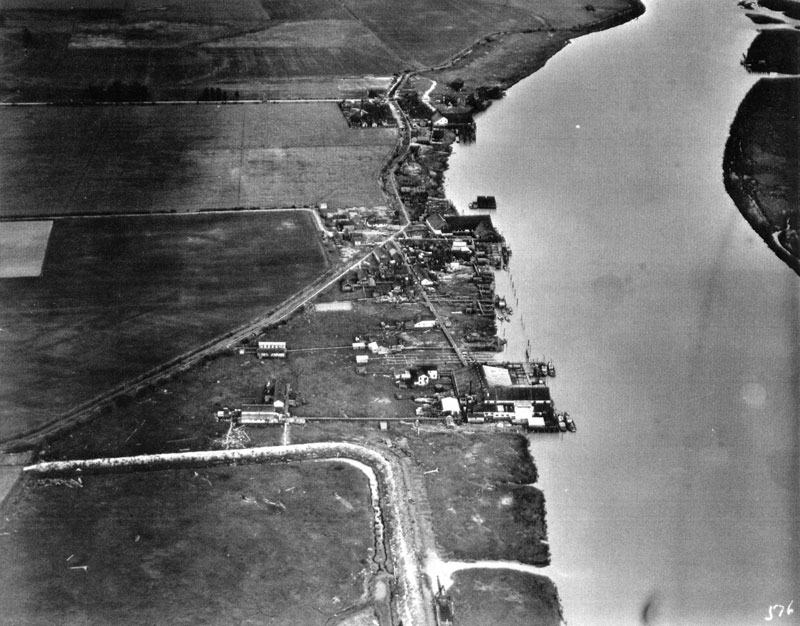
Acme Cannery (top) and Vancouver Cannery (bottom) on southwest corner of Sea Island, 1932
(City of Richmond Archives 1985 166 101)
About Sea Island
The success of the salmon canning industry in the Fraser River varied over the years, but in the ‘boom years’ of 1870-1890, there were large runs of salmon in the north, middle and south arms of the Fraser River accompanied by high demands from foreign markets.
Fishermen came from Japan as early as 1877, looking for work opportunities and a better life. Many from Mio and Koza, Wakayama, and from Kagoshima, Japan, had heard the promising stories of those already here and decided to come to Canada to work in the expanding salmon industry. Many went to Steveston, while some settled on Sea Island. Vancouver Cannery (1896 – 1930) and Acme Cannery (1889 – 1918) on the southwest shores of Sea Island on the middle arm of the Fraser River welcomed the fishermen.
Strength and Spirit of Community
Through documented accounts from individuals who lived at or nearby Acme and Vancouver canneries, as well as recollections passed down to Japanese Canadian descendants, we learned about daily life at the canneries that contributed to a strong spirit of co-operation and community.
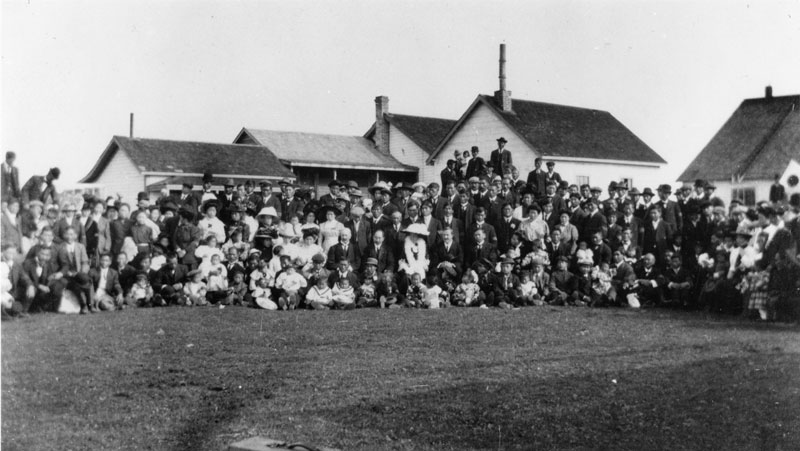
Most residents worked as fishermen, in canneries, or supported the community through boat building, fish collecting, or farm work. Despite hardships and basic living conditions—some in huts, bunkhouses, or self-built shelters—they saw one another as equals. Fishing provided a stable livelihood, prompting many to become citizens. Single men often brought Japanese wives to Canada through arranged marriages. Community activities like church, school, sports, and youth groups strengthened unity and identity. Their strong sense of community was on display when the Japanese Consul and his wife visited in 1912.
The Japanese Consul and his wife visit the Japanese community living at the canneries on Sea Island.
(City of Richmond Archives)
As members of the Japanese Canadian community on Sea Island were not landowners, their children could not attend public schools. Valuing education, they worked together to establish Sea Island School for the children who lived at the canneries. They agreed to provide a school room and equipment and furnish supplies. The Richmond School Board paid the salary of the teacher. It was the only school operating on Sea Island at the time and consisted of three rooms in two buildings on the wharf at Vancouver Cannery.
In the late 1930s, public school was available to cannery children. They took a school bus to Bridgeport Elementary on Lulu Island with local farm kids. After school, they attended Japanese Language School at Vancouver Cannery.
Free Time
Roy Nagata remembers playing with siblings and friends on the sandbars at low tide, building sandcastles or digging a bucket of surf clams further downstream using a rowboat. At high tide, they would go to the docks and dive off the diving board that was built by the community. He recalled that a friendly game of box lacrosse was always a great way to warm up before a swim. He shared that fall and winter sports were limited to basketball and skating whenever the high tide overflow of the dikes froze long and safe enough to skate on.
Toshitsugu (Toshi) Koyanagi also enjoyed playing with others on the sandbar in the summer when the tide went out, while heeding a warning from his parents to be careful around the water. Several drownings occurring in the past served as painful reminders of what could happen to those living so close to the river's edge.
Children at the canneries gathered firewood from the beach or transported it by wheelbarrow to where it was needed. At school, students took turns loading coal and heating the stove.
Social Activities
The Young People’s Society and sports were important to Japanese Canadian life on Sea Island’s southwest shore. The Sea Island Young People’s Society hosted social events for the community.
Sea Island Young People's Society, 1939 (City of Richmond Archives 2013 81)
In the late 1930s, the Sea Island Hurricanes lacrosse team played near the canneries on Mr. Erskine’s property. They purchased their own equipment and used seine nets to keep the ball in play. The team competed both internally and with nearby communities. They were the 1939 Nisei Lacrosse League Champions.
The community also hosted a Sea Island Pentecostal Sunday School; families went to church together on Sundays, and Foursquare services were held in the school hall.
Fishing, Cannery Work and Boat Building
Fishing and cannery work peaked from May to October, with many workers moving to other industries like railroad, mining or logging camps during the off-season. Some workers stayed at the canneries to do repairs and maintenance, and to make cans and corks needed for next season. Many of the Japanese Canadians took on those made-by-hand tasks at the canneries.
While men were fishing, women often worked in the canneries. With mechanization of the canning process improving, rather than making cans or cutting the salmon, women spent their working hours hand-filling cans, often with their children on their backs.
At first, fishermen did not own boats and had to rely on those that belonged to the canneries, most often small, two-man wooden sailboats. By the early 1900s, Japanese Canadians were building most of the wooden boats used in the fishing industry. Many now owned and operated their own small fishing boat(s).
As a young man Toshi Koyanagi was involved in the fishing industry as a fish collector. A boat he used at Acme and Vancouver canneries was the Iona, built in the 1930s. It was a double-ender where the bow and stern both came to a point. Daily, collectors left the canneries in boats like the Iona to collect fish from smaller fishing boats at the mouth of the Fraser or farther out at sea. The collectors would pack the fish on ice and transport the catch to the canneries. In this way, fishing boats could remain on the water for longer periods of time during the short fishing season.
Japanese Canadian Internment - 1942
Prior to WWII, Japanese Canadians at Acme and Vancouver Canneries formed a thriving community. After the Pearl Harbour bombing in December 1941, the Canadian government classified these coastal residents as security threats and forcibly relocated most—many Canadian-born—to camps inland, confiscating property and demolishing homes. The last evacuation occurred on March 31, 1942; only personal belongings could be taken.
The burning of Japanese Canadian houses at the Acme Cannery on Sea Island (City of Richmond Archives 2000 15 2)
Despite challenging conditions, internees showed resilience. In 1944, Toshi married Shuzuko Yamada in New Denver, BC, where they both worked at a sanitarium; their son Leonard was born there.
The restrictions imposed under the War Measures Act were lifted March 31, 1949. Some returned to Richmond, B.C. In 1950, Sadajiro Asari and his family returned to Steveston where Sadajiro worked in the shipbuilding industry. He lived through much change, from building small wooden sailboat-type fishing vessels to much larger, more mechanized seiners.
In 1950, Toshi and his family returned to Sea Island and settled at 376 Shannon Road. Upon their return, Toshi was reunited with the Iona through William Montgomery, who had acquired the vessel from Crown Assets following the sale of confiscated properties. Grateful for the opportunity to continue his work, Toshi resumed his role as a fish collector with Nelson Brothers, a position he held for at least another decade. In 1955, Toshi relocated his family to Steveston. The Iona underwent a significant modification in 1960, with its aft deck being redesigned to accommodate a larger fish hold, thereby altering its original double-ended configuration.
The Iona was transferred to the City of Richmond (Britannia Steering Committee) on October 18, 1991. Despite some restoration efforts, extensive repairs are required due to the prolonged period the wooden vessel spent in water. Currently, the Britannia Shipyards National Historic Site showcases the well-travelled Iona in dry dock, with potential for further restoration.
The Iona - Britannia Shipyards National Historic Site in Richmond, British Columbia (Marylin Low)
Over forty years after their community was dissolved under the 1941 War Measures Act, former Japanese Canadian residents of Sea Island, Terra Nova, and Celtic Canneries reunited to honour the lasting bonds forged during cannery life. The Nikkei community's resilience to this day endures.
Click any of the buttons below to read more about each subject.
Thomas Goulding operated a cork mill at the Acme cannery docks, producing corks and floats from red cedar for use in gillnets. The mill continued its operations until it was expropriated by the Federal Government in the mid-1950s.
By the 1870s, canning methods transitioned from glass containers to tinplate. At the Richmond Cannery (1882–1905), located west of Vancouver and Acme Canneries, workers hand-cut tinplate and shaped it on wooden cylinders. Solder was used to join the sides, tops, and bottoms of the cans. These cans were produced manually during the off season and stored for use during the fishing season. In the late 1890s and early 1900s, the process changed as both can manufacturing and fish processing advanced, with mechanization increasingly replacing manual labor in the canning industry.
We offer three arrival stories of those who came from Japan to work in the fishing industry, settling on the southwest shore of Sea Island.
Sadajiro Asari from Koza, Wakayama, Japan
Sadajiro Asari arrived at Sea Island with his father in 1912 at the age of 15. He began working as a fisherman and resided alongside his father at the local canneries. Later, Sadajiro arranged for his bride, Some, who originated from the same village of Koza, to join him in Canada. The couple married on January 28, 1918, and established their home in a hut on the dike between the Vancouver and Acme canneries, which Sadajiro constructed using wood gathered from the river. Together, they raised five children in this residence.
Saichiro Higo from Kagoshima, Japan
Saichiro resided on Sea Island at Acme Cannery with his wife, Yui, around 1913. He was employed as a fisherman. Yui worked at the nearby Vancouver Cannery, packing salmon by hand, and also worked with other women in a neighbouring farmer’s field for a wage of 10 cents per hour. She maintained a vegetable garden and raised ten children during their time at Acme. Yoshie, the eldest child, was born in Japan, while the remaining nine children were born on Sea Island: Terue “Betty,” Sadaichi (born 1916, died 1921), Yukio “Frank,” Hideko “Mary,” Yukinori “Ted,” Shizuno (born 1922, died 1922), Hatsue “Pat,” Kuniko “Barb,” and Yoshiharu, who died at birth in 1931.
Sanshiro Nagata from Kagoshima, Japan
Sanshiro Nagata maintained a relationship with his older brother, Saichiro Higo. The exact date of the Nagata family's arrival on Sea Island is unclear, but it is likely that Saichiro played a role in their decision to move to Canada. Sanshiro and his wife, Saye, had six children: Fumiko “Fumi,” Yukiye “Yuki,” Masatoshi “Jerry,” Hisako, Reiko, and Masahiro “Roy.” Fumi and Yuki were born in Japan and lived there for fifteen years before migrating to Canada. The remaining siblings were born on Sea Island prior to 1942. The family resided at Acme Cannery.
Until the Canadian government sent all Japanese individuals to internment camps, Sea Island had a vibrant Japanese community along with a few other families concentrated around the canneries. As the Sea Island Heritage Society continues to learn more about the heritage of the Japanese and other Canneries Community families, new content will be added to our website.
The following is a list of families who lived in cannery-owned housing on Sea Island in 1936 obtained from the City of Richmond Archives MR 6, File 603-3, along with a list of Japanese Canadians who originated from Sea Island obtained from the University of Victoria Japanese Canadians Legacies Monument Names database. The Legacies Monument Names database continues to be updated. For a more comprehensive list and updates, please visit the Japanese Canadians Legacies Monument Names database.
List of Japanese and other families living in cannery-owned housing on Sea Island in 1936
Doi, T.
Kawamoto, C.
Minimide, H.
Shimizu, T.
Fugino, M.
Kawasoye
Mizuno, S.
Shimizu, Tom
Fukuhara, H.
Kawasoye, S.
Mori, T.
Shimona, S.
Furakawa, A.
Kimura, S.
Morimoto, S.
Shinkawa, H.
Hamamoto
King
Morishita, E.
Takahashi, S.
Hamanishi, S.A.
Kitade, Y.
Mukai, S.
Tamura, J.
Hashimoto, K.
Kobayashi, G.
Murakami, K.
Tani, S.
Hayashi, M.
Kokubo, T.
Murao, K.
Teranishi, Y.
Hayashi, Y.
Kosaka, J.
Murao, Y.
Teshima, Kanjiro
Hibi, T.
Koshiba, T.
Nagai, M.
Tsuji, T.
Higo, S.
Koyanagi, C.
Nagata, S.
Tsumoto, M.
Higo, Z.
Koyanagi, Kikiji
Nakagawa, Y.
Umemura, I.
Hirata, I.
Koyanagi, Kiyoichi
Nakahara, T.
Uraisami, H.
Hirikida, K.
Koyanagi, M.
Nakamichi, T.
Umemura, I.
Hirota, I.
Koyanagi, S. O. (Mrs.)
Nakano, K.
Uyeda, H.
Homaura, K.
Kurayashi
Nakatsu, K.
Uyeyama, I.
Hori, K.
Maikawa, C.
Narukami, K.
Yamamoto, S.
Husband, L.
Maikawa, E.
Nasu, B.
Uyeyama, I.
Ikebata, S.
Mase, A.
Nomura, M.
Yamasaki, B.
Ikeuichi, Y.
Masuda, G.
Obayashi, H.
Yamashita, M.
Imoto, Y.
Matsubara, C.
Okamoto, H.
Yoddakawa, M.
Ishibashi, K.
Matsubara, K.
Okano, H.
Yoneda, H.
Ito, T.
Matsumoto, T.
Okano, M.
Yonekura, T.
Kanda, Y.
Matsushita, T.
Phillips
Yoshida, K.
Katai, I.
Minamide, K.
Saki, H.
Yoshida, Y.
Katai, Y.
Minamide, M.
Sasaki, E.
Katsumi, K.
Minamimaye, H.
Shibata, K.
Minamimaye, R.
Shiho, Y.
List of Japanese Canadians originating from Sea Island
Asari, Chiyo
Higo, Yoshie
Koyanagi, Michiyo
Nagai, Matsunosuke
Asari, Kikue
Higo, Yoshiharu
Koyanagi, Misao
Nagai, Ronald Aeiji
Asari, Nobuye
Higo, Yoshinori
Koyanagi, Sakumatsu
Nagai, Shigeo
Asari, Sadajiro
Higo, Yui
Koyanagi, Shio
Nagai, Tadao
Asari, Some
Higo, Yuki
Koyanagi, Shiro
Nagai, Umeko
Asari, Suyeko
Higo, Yukinori
Koyanagi, Tadashi
Sasaki, Chiyo
Asari, Takeno
Higo, Yukio
Koyanagi, Tadatoshi
Sasaki, Eiji
Asari, Takino
Higo, Zentaro
Koyanagi, Tamae
Sasaki, Mitsuru
Asari, Yasu
Hirakida, Aiko
Koyanagi, Wataru
Sasaki, Senji
Asari, Yoshio
Hirakida, Akira
Koyanagi, Yasushi
Tanaka, Barbara Keiko
Baba, Harry Noboru
Hirakida, Chiyoko
Kuwada, Atsumi
Tanaka, Mutsuko
Baba, Shimpei
Hirakida, Hakino
Kuwada, Hisao
Takano, Hisashi
Baba, Tomio
Hirakida, Katsumi
Kuwada, Toki
Takano, Mamoru
Fukushima, Harry Isamu
Hirakida, Setsuko
Matsumoto, George
Takano, Osamu
Fukushima, Jisuke
Hirakida, Sueo
Matsumoto, Naka
Takano, Shizue
Fukushima, Shigeshi
Hirakida, Takashi
Matsumoto, Toshi
Takano, Tatsuo
Fukushima, Susumu
Koyanagi, Chieko
Matsumoto, Yoshimatsu
Takano, Teruo
Fukushima, Toshi
Koyanagi, Chikara
Matsumoto, Yoshino
Tsumoto, Haru
Fukushima, Tsutomu
Koyanagi, Ichiro
Morimoto, Kunio
Tsumoto, Matsujiro
Higo, Barbara Kuniko
Koyanagi, Jun
Morimoto, Ritsu
Uyeda, Sojiro
Higo, Betty Terue
Koyanagi, Kanae
Morimoto, Shigeru
Yamada, Hideo
Higo, Mary Hideko
Koyanagi, Katsuyo
Morimoto, Takeo
Yamada, Isakichi
Higo, Patricia Hatsue
Koyanagi, Kazue
Morimoto, Teruko
Yamada, Katsu
Higo, Saichiro
Koyanagi, Keiichi
Morimoto, Yaeko
Yashiki, George
Fukushima, Tsutomu
Koyanagi, Ken
Nagai, Aiko
Yashiki, Wakamatsu
Higo, Toshitsugu
Koyanagi, Kisa
Nagai, Chiyo
Yasunobu, Edward Isasmu
Higo, Yasuyuki
Koyanagi, Matashiro
Nagai, Kiyoshi
Yasunobu, Kumiko
The Society is grateful for conversations with the late Doreen Braverman and Leonard Koyanagi, as they recalled and shared more details of their personal experiences, and the close friendships they made.
To learn more about canneries and the Japanese-Canadian community on Sea Island:
Read Bill McNulty's Sea Island British Columbia, The Beginning of Richmond (Chapters 3-5).
Read Leslie J. Ross’ Richmond Child of the Fraser (Harvesting the River pp. 111-130), available online as a PDF. Retrieved on August 9, 2021.
Read Mary Keen’s history of Sea Island A Bridge to the World (Canneries on pp. 26-28), available online as a PDF. Retrieved on August 10, 2021.
Read Doreen Braverman’s account of her time at the cork mill with the owner, her grandfather, Thomas Goulding, in the 2008 Summer Issue of Nikkei Images, Volume 13, No. 2, pp. 3-4, available online as a PDF. Retrieved on August 10, 2021.
Read Japanese Canadians on Sea Island presented by Friends of the Richmond Archives, available online. Retrieved on August 10, 2021.
Read Spirit of the Nikkei Fleet: BC’s Japanese Canadian Fishermen by Masako Fukawa with Stanley Fukawa and the Nikkei Fishermen’s History Book Committee for a full historical perspective “of ordinary people who faced inequity, prejudice and inhumanity with an indomitable spirit” (p.9).
Read Maritime Vessel Management Report to the City of Richmond that includes information about the Iona and its sale to the Britannia Shipyards National Historical Site.
View the Gulf of Georgia Cannery Society’s Tides to Tins website to learn about the history of salmon canning in B.C., including a historical timeline with images and an interactive map.