We are a non-profit organization focused on promoting, preserving, and being a strong, active resource for all things of heritage value on Sea Island in Richmond, British Columbia. Join us to learn about the history of Sea Island and its residents, past and present.
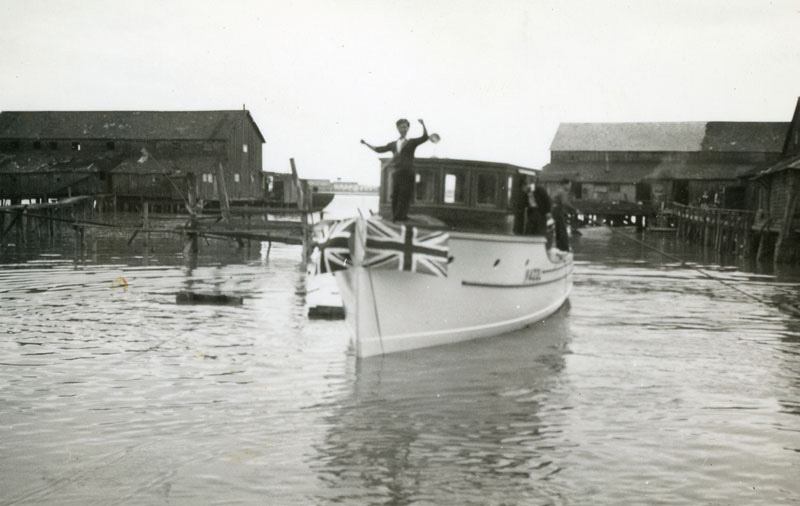
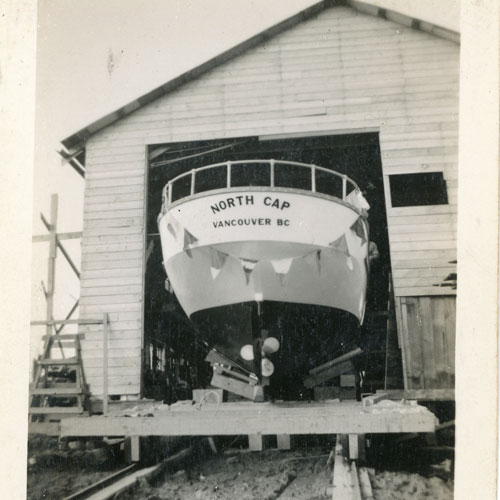
The launching of the Amorita (V422L) on May 2, 1942, from the Baba Bros. Boat Works area on Sea Island.
(Baba Family Collection)
About Sea Island
In the late 1800s, Japanese immigrants from coastal Japan brought woodworking tools and techniques across the ocean to build a new and better life in Canada. From Steveston, in Richmond, British Columbia to the North Shore of Vancouver and all the way up the coast along the Fraser River, families set up boat works along rivers and coastlines. Three boat works set up shop on the southwest shores of Sea Island by the Acme Cannery, the Asari Boat Works, the Baba Bros. Boat Works and a third boat works name unknown at this time.
Magosaburo and Hatsu Baba
Magosaburo Baba came to Canada in 1900 leaving his wife Hatsu and their young son, Takajiro, in Japan. After working as a builder in San Francisco, and a millright in Vancouver, British Columbia, he had enough money to send for Hatsu and Takajiro. The family settled in the Acme Cannery community on Sea Island, where Magosaburo started building fishing and pleasure boats. Magosaburo passed on his building skills to his sons and by the 1930s, Shimpei, Tomio and Noboru owned Baba Bros. Boat Works at the bottom of Shannon Road on Sea Island.
The Sea Island Heritage Society did extensive research on the Baba family and Baba Bros. Boat Works.
The longer version of their story along with more photos can be made available upon request.
Baba Bros. Boat Works and Home
The Baba family had been building boats since Magosaburo and Hatsu settled in the Acme Cannery community with Takajiro in 1909. It is unknown where they first lived or where they built their fishing boats before the 1930s. The patriach, Magosaburo and their only daughter, Mitsu, died of tuberculosis in 1925 and 1926 respectively. And, by 1933, Takajiro had moved to New Westminster with his wife, Shizuko (Jean). The matriarch, Hatsu, moved in with them. The three younger Baba brothers, Shimpei (George), Tomio and Noboru (Harry) lived in Acme Cannery house number 4.
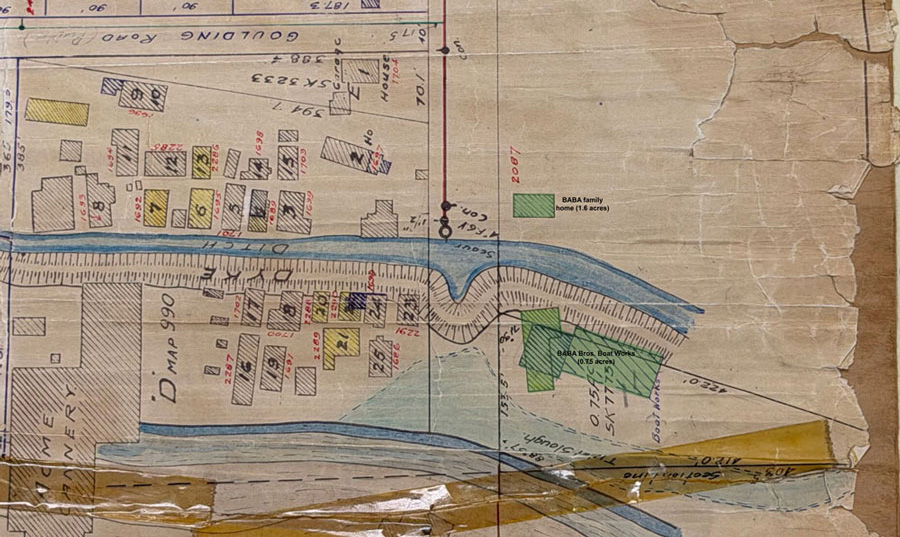
Baba home and Baba Bros. Boat Works in green, southwest corner of Sea Island on Waterworks Atlas map, 1936. (City of Richmond Archives 1991 40 3 - Maps 19)
In 1936 and 1940, Shimpei, Tomio and Noboru Baba bought two parcels of land, portions of Section 27, Block 5 North, Range 7 West from Mr. William Nicoll on Sea Island. They bought the first parcel on May 1, 1936, a 0.75-acre property located on the south side of the dyke, at the bottom of Shannon Road (Road No. 11), to the east of the junction with Shannon Road (sketch 7773 on the Waterworks Atlas map above). BABA Bros. Boat Works was built on this parcel of land and consisted of two boathouses, one 36 x 80 feet and one 36 x 25 feet.
On February 20, 1940, Shimpei, Tomio and Noboru entered into a legal partnership agreement regarding Baba Bros. Boat Works that acknowledged the partnership had already existed since they bought the 0.75-acre property in 1936. The agreement also stated that each brother owned one third of the land and business, the books were to be kept under the control of George Shimpei Baba and always accessible to Tomio and Noboru and the profits be divided between the three brothers, yearly, on the last day of June and the last day of December. Their older brother, Takajiro, worked with his younger brothers.
On June 19, 1940, Tomio and Noboru bought the second parcel from Mr. Nicoll’s estate on the north side of the dyke from the southwest corner of Section 27, immediately adjoining the parcel purchased in 1936. The 1.6 acres included the house already occupied by the Baba brothers and included the dyke, but excluded the ditch. Shortly after they bought the land, the Baba brothers built a new five-room house with a metal roof where Tomio, Noboru and their brother Shimpei lived until 1942 when they were uprooted and sent to internment camps.
Land dispute
In 1942, the Baba family was uprooted from the Coast and first evacuated to Kaslo, British Columbia where they were interned. Within a few months of internment in Kaslo, the matriach, Hatsu, passed away. Tomio and his family remained in Kaslo while Takajiro, Shimpei and Noboru were further interned in the Chatham, Ontario area. During their internment, Shimpei, Tomio and Noboru had to deal with the Office of the Custodian over their assets confiscated by the Canadian government. On January 30, 1945, the Office of the Custodian sold the 1.60-acre property with the Baba home to William Herbert Willson for $400.00, and on September 20, 1948, they sold the 0.75-acre property and the Baba Bros. Boat Works to Rene Kyme for $1,200.00. Willson had been complaining to the Office of the Custodian that the boat works from the 0.75-acre property was encroaching on his property and the entrance to Baba Bros. Boat Works was on his property since he bought it in 1945. A land dispute between the two parties and the Office of the Custodian ensued.
Japanese Fishing Boats
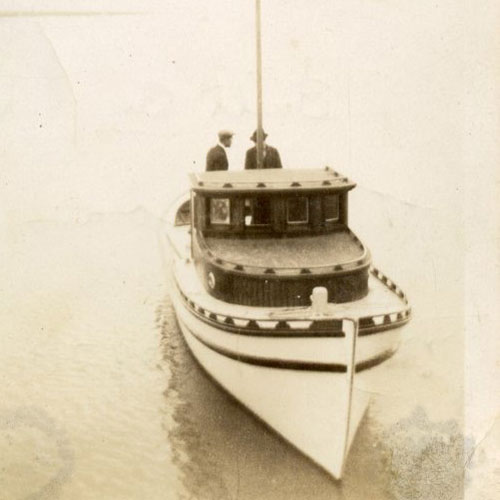
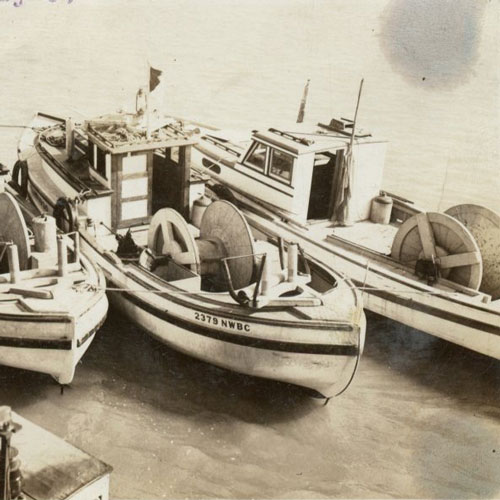
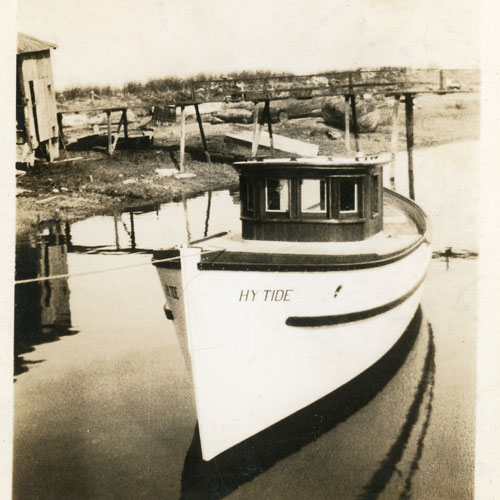
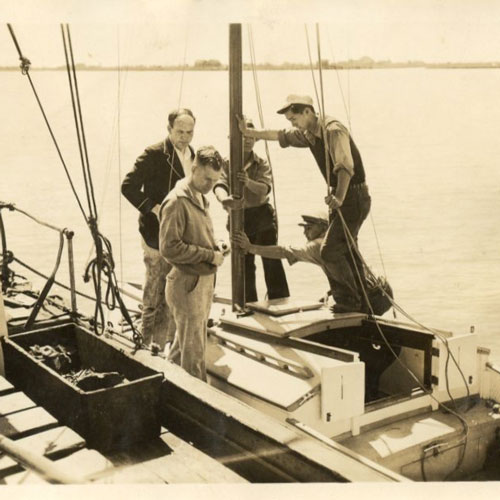
Tomio, Shimpei and Noboru built at least one vessel per year at Baba Bros. Boat Works, usually during the winter months. They kept the newest boat and sold the oldest in their small fleet which they used for fishing during the summer months. The boats were based on original Japanese designs from across the Pacific where fishing had been practiced for centuries. It is estimated that the Baba family built over 250 fishing boats from the time the patriach, Magosaburo, arrived on Sea Island in 1909 to the establishment of Baba Bros. Boat Works by his sons in the 1930s up to 1942 when the Baba family was uprooted and sent to internment camps. Shimpei and Tomio were the last two members of their family evacuated to Kaslo. They had received permission to remain in the "protected area" long enough to finish the last boat to be launched from the Baba Bros. Boat Works on Sea Island. The Baba brothers had built the Amorita II in 1941 which was owned by Captain Amos Beckman. The Royal Canadian Air Force (RCAF) requisitioned Captain Beckman's boat. Shimpei and Tomio finished the work on the Amorita II which was launched on May 2, 1942. It was renamed the M.449 Jager by the RCAF. Four days later, Shimpei and Tomio were on their way to interment in Kaslo.
On April 1, 1949 (four years after WWII ended) Japanese Canadians were granted freedom of movement and allowed to re-enter the "protected zone" along the British Columbia coast. Many tried to return to re-establish their businesses and livelihoods and found all kinds of hardships. Boat builders found their yards derelict or destroyed, tools unaccounted for and the prospect of business slight. And the Japanese homes on Sea Island had been burnt to the ground. This convinced the Baba brothers to remain in Kaslo and the Chatham, Ontario area. They never returned to the Coast. There was nothing to return to.
Click any of the buttons below to read more about each subject.
In the early 1950s, Tomio Baba purchased the dilapidated Langham Hotel building where many Japanese, including himself and his family, had been interned and used it for his shop for about twenty years. A large door was built in the rear and the Langham Hotel became the new Baba Bros. Boat Works and carpentry shop.
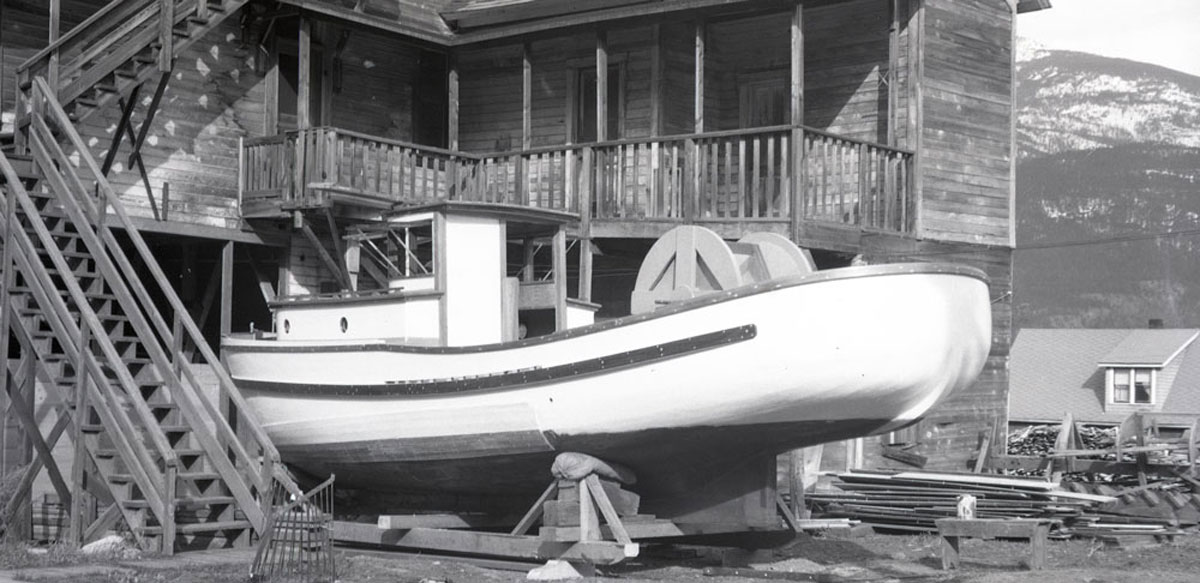
Gillnetter built by Tomio Baba and his crew at the Langham Hotel in Kaslo, British Columbia, circa 1950.corner of Sea Island on Waterworks Atlas map, 1936. (Baba Family Collection)
Three 30 to 40-foot ocean-going gillnetters were built at the Langham including the Jean A and Sure Thing. Tomio also built a crew boat which transported workers to the Bluebell Mine in Riondel.
One of the major tools used by Tomio and his crew was a wood board steamer described as this long wooden box about 1-foot square and over 30-feet long with a hinged door at one end where the wood boards were inserted and a large boiler with a metal tube, essentially an upscaled kettle with its spout securely fastened to the box. Steam from the boiler passed into the box and circulated around the boards inside, making them soft and pliable so that, with a good pair of gloves and some deft movements, they could be bent into shape and quickly fastened to the temporary template forms of the boat under construction.
The Society relied on numerous legal documents, summaries of interviews and websites, along with the input of Harold Baba and his siblings (descendants of Tomio Baba) and Kathleen Baba Willison and Frances Baba Hall (descendants of Noboru Baba). Each Office of the Custodian document was located through the Landscape of Injustice database and Library and Archives Canada. Birth, death and marriage certificates were obtained through the Royal British Columbia Museum genealogy section. Photos of the Baba family members and the boats built by Baba Bros. Boat Works were obtained from the Baba families.
The Society retained a copy of all sourcing documents and photographs used to write the stories. All are available upon request.